
.png)
How Are ADHD and PTSD Connected? Understanding the Overlap
Quick answer: ADHD and PTSD share overlapping symptoms—like inattention, restlessness, and emotional outbursts—because both conditions affect similar brain regions involved in focus and stress response. Research shows ADHD raises the risk of developing PTSD after trauma, and trauma itself can produce ADHD-like symptoms. Because the two conditions can mask or amplify each other, accurate diagnosis and careful treatment sequencing are essential (Biederman et al., 2013; Arnsten, 2009).
If you've ever wondered whether your inattention is ADHD, PTSD, or both, you're not alone. Attention-Deficit/Hyperactivity Disorder (ADHD) and Post-Traumatic Stress Disorder (PTSD) are two distinct diagnoses, but they frequently show up together, and they can look remarkably similar from the outside. A person struggling to concentrate, sit still, or manage their temper might be dealing with either condition, or a combination of both.
This overlap isn't coincidental. ADHD and PTSD share common ground in brain chemistry, stress response systems, and even the life circumstances that make trauma more likely in the first place. Understanding how these two conditions interact can help you make sense of your own experience, or support someone you care about, and can guide more accurate diagnosis and treatment.
Below, we'll break down what the research says about the ADHD-PTSD connection: how common it is, why the symptoms overlap, what's happening in the brain, and what effective treatment looks like.
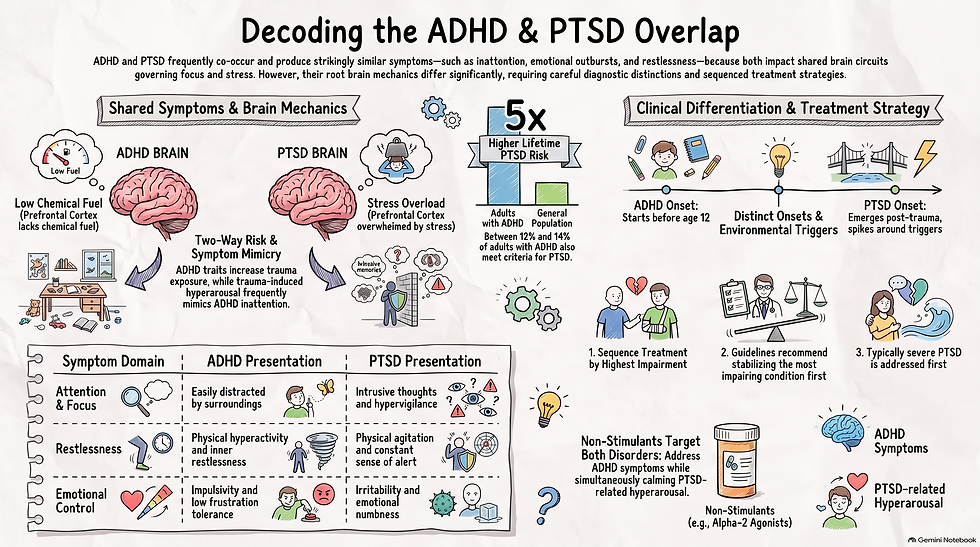
How common is it to have both ADHD and PTSD?
ADHD and PTSD co-occur far more often than chance would predict. Research estimates that 12% to 14% of adults with ADHD also meet diagnostic criteria for PTSD (Biederman et al., 2013). In Biederman and colleagues' (2013) longitudinal study, adults diagnosed with ADHD in childhood had roughly five times the rate of lifetime PTSD compared to a control group without ADHD, about 10% versus 2%. That gap held even after the researchers accounted for other psychiatric conditions, suggesting ADHD independently raises PTSD risk rather than simply reflecting a generally higher burden of mental illness.
The pattern holds in children, too. A systematic review and meta-analysis by Spencer et al. (2016) found a statistically significant link between childhood ADHD and the later development of PTSD following trauma exposure. The authors concluded that ADHD doesn't just make children more likely to encounter traumatic events. It also makes it harder for them to process those events, increasing the odds that the trauma develops into full-blown PTSD.
Why do ADHD and PTSD symptoms look so similar?
If you've compared symptom checklists for ADHD and PTSD, you've probably noticed they overlap in several places. This overlap is one of the biggest reasons the two conditions are frequently confused or missed.
Symptom Domain | How It Shows Up in ADHD | How It Shows Up in PTSD |
Attention & Focus | Difficulty sustaining attention, easily distracted by surroundings | Trouble concentrating due to intrusive thoughts, hypervigilance, or dissociation |
Executive Function | Poor working memory, disorganization, trouble managing time | Cognitive difficulties driven by chronic stress and an overworked threat-response system |
Restlessness | Physical hyperactivity, inner restlessness, trouble sitting still | Physical agitation, muscle tension, a constant sense of being on alert |
Emotional Control | Impulsivity, low frustration tolerance, mood swings | Irritability, anger outbursts, emotional numbness, intense reactivity |
Sleep | Racing thoughts that delay falling asleep | Insomnia from hyperarousal, nightmares, fear of sleep |
This overlap isn't superficial. Brown (2013) explains in his clinical reference on ADHD that the disorder stems from deficits in executive functions like working memory and effort regulation. Those exact same deficits can appear in someone with PTSD, not because they have a neurodevelopmental disorder, but because chronic hyperarousal and dissociation consume the mental resources needed to focus. A clinician looking only at symptoms, without a full history, can easily mistake one condition for the other.
Emotional regulation adds another layer of overlap. Surman et al. (2013) describe "deficient emotional self-regulation" as a core feature of ADHD, not just a side effect, showing up as low frustration tolerance and quick anger. Since emotional dysregulation is also central to PTSD, someone with both conditions may experience emotional swings that are more intense and harder to manage than either disorder would cause alone.
What's happening in the brain when someone has both conditions?
The symptom overlap between ADHD and PTSD traces back to shared circuitry in the brain, particularly the networks connecting the prefrontal cortex, the amygdala, and the body's stress-response system.
The prefrontal cortex struggles in both conditions, but for different reasons. The prefrontal cortex is the brain's control center for planning, focus, and impulse control. In ADHD, this region runs on a chronic shortage of catecholamines, the chemical messengers dopamine and norepinephrine, which weakens its ability to manage attention and behavior (Arnsten, 2009). In PTSD, acute or ongoing stress floods the brain with those same catecholamines, which paradoxically shuts down prefrontal cortex activity and reduces its ability to rein in the amygdala. Choose to think of ADHD as a prefrontal cortex running low on fuel, and PTSD as one that's been overwhelmed by too much, and you can see why both end up with similar executive function problems.
The amygdala runs hot in both disorders. PTSD is well known for an overactive amygdala, the brain's threat-detection center, which keeps a person scanning for danger even in safe situations. Research shows people with ADHD also display atypical amygdala activity, which lines up with the emotional reactivity common in the disorder (Arnsten, 2009).
Stress hormones add fuel to the fire. The hypothalamic-pituitary-adrenal (HPA) axis governs the body's stress response. Heim and Nemeroff (2001) found that early-life trauma can permanently alter this system, leaving someone with a hair-trigger stress response well into adulthood. For a person who already has ADHD-related differences in HPA axis function, this added stress sensitivity can make them more vulnerable to developing PTSD after a traumatic event.
Can ADHD cause PTSD, or does it work the other way around?
The relationship between ADHD and PTSD runs in both directions, and understanding each pathway matters for prevention and treatment.
ADHD can increase the risk of experiencing trauma in the first place. Barkley (2015) documents how impulsivity, poor risk assessment, and novelty-seeking, all hallmark ADHD traits, lead to more car accidents, physical injuries, and interpersonal conflict. Simply put, the behavioral patterns associated with ADHD put people in harm's way more often, which creates more opportunities for traumatic experiences to occur.
ADHD can also make it harder to recover from trauma once it happens. Cognitive difficulties linked to ADHD, such as poor working memory and limited cognitive flexibility, can interfere with a person's ability to process and make sense of a traumatic event. Spencer et al. (2016) suggest this is a key reason trauma is more likely to develop into clinical PTSD in people who already have ADHD.
Trauma can also produce symptoms that look exactly like ADHD. Daud and Rydelius (2009) studied children exposed to severe trauma, including war and displacement, and found that hyperarousal and intrusive thoughts often showed up behaviorally as inattention and hyperactivity. In other words, a child who appears to have ADHD may actually be responding to unresolved trauma. This is why trauma-informed assessment is so important before assigning a primary ADHD diagnosis, especially in children with a history of adversity.
How do clinicians tell ADHD and PTSD apart?
Given the symptom overlap, a careful developmental history is the clearest way to distinguish the two conditions, or to identify when both are present. The DSM-5 (American Psychiatric Association, 2013) lays out the key differences clinicians look for:
When symptoms started: ADHD is a neurodevelopmental condition, meaning symptoms must be present before age 12. PTSD symptoms emerge, or significantly worsen, after a traumatic event, though trauma that occurs very early in life can blur this timeline.
What triggers the inattention: ADHD-related inattention tends to be constant and worse during boring or repetitive tasks. PTSD-related inattention is often episodic, triggered by reminders of the trauma, and accompanied by hypervigilance or intrusive memories.
How symptoms respond to the environment: ADHD symptoms stay fairly consistent across different settings. PTSD symptoms spike around trauma-related triggers or anything that feels threatening.
What's the best treatment approach when someone has both ADHD and PTSD?
Treating co-occurring ADHD and PTSD requires more coordination than treating either condition alone, since each one can affect how well the other responds to treatment.
Deciding what to treat first matters. Clinical guidelines from the National Institute for Health and Care Excellence (2018) recommend treating the most impairing condition first when ADHD co-occurs with another psychiatric disorder. In practice, this often means stabilizing severe PTSD symptoms through trauma-focused therapies, such as EMDR, Cognitive Processing Therapy, or Prolonged Exposure, before layering in ADHD-specific treatment. That said, some clinicians find that addressing ADHD first can build the executive function and emotional regulation skills a person needs to fully engage in trauma therapy. Choose the sequence based on which symptoms are causing the most day-to-day harm.
Medication requires careful monitoring. Stimulant medications like methylphenidate and amphetamines are highly effective for ADHD, but they can worsen PTSD symptoms such as anxiety, hyperarousal, or a racing heart, so they need close supervision in people with both conditions. Non-stimulant options often work well as an alternative. Atomoxetine and alpha-2 adrenergic agonists, such as clonidine and guanfacine, are especially useful because they target ADHD symptoms while also calming PTSD-related hyperarousal, nightmares, and stress reactivity (Strawn et al., 2010).
Combined therapy tends to work best. Pairing cognitive-behavioral strategies that build executive function skills with trauma-informed therapy generally produces the strongest outcomes, since it addresses both the attention difficulties and the underlying trauma response at the same time.
Getting the right diagnosis is the first step toward feeling better
ADHD and PTSD can look alike on the surface, but they stem from different root causes, and treating one while missing the other rarely leads to lasting improvement. If you recognize symptoms of both conditions in yourself or someone you care about, a thorough evaluation with a clinician who understands trauma and neurodevelopmental conditions is the clearest path forward. A detailed history, covering when symptoms started, what triggers them, and whether trauma is part of the picture, gives you the clarity needed to pursue treatment that actually addresses what's going on.
Frequently asked questions
Can you have ADHD and PTSD at the same time?Yes. Research shows up to 12–14% of adults with ADHD also meet criteria for PTSD, a rate far higher than in the general population (Biederman et al., 2013).
Does ADHD make someone more likely to develop PTSD?Yes. ADHD is considered an independent risk factor for trauma exposure and for developing PTSD after a traumatic event, partly because impulsivity increases the chance of experiencing trauma, and partly because ADHD-related cognitive difficulties can make it harder to process traumatic experiences (Barkley, 2015; Spencer et al., 2016).
Can trauma cause symptoms that look like ADHD?Yes. Chronic hyperarousal and intrusive thoughts from trauma can produce inattention and restlessness that closely resemble ADHD, especially in children (Daud & Rydelius, 2009). This is why a trauma-informed evaluation is important before diagnosing ADHD in someone with a trauma history.
Is it safe to take ADHD medication if you also have PTSD?It depends on the individual. Stimulant medications can sometimes worsen PTSD symptoms like anxiety and hyperarousal, so they require close monitoring. Non-stimulant options, such as atomoxetine or alpha-2 agonists like guanfacine, are often better tolerated and can help with both conditions at once (Strawn et al., 2010).
Which condition should be treated first, ADHD or PTSD?Clinical guidelines generally recommend treating the most impairing condition first, which often means stabilizing severe PTSD symptoms before starting ADHD-specific treatment. However, some people benefit from building ADHD-related coping skills first to better engage in trauma therapy (National Institute for Health and Care Excellence, 2018).



Comments